Linking Highschool Education with College: Case Study of Industrial Engineering - Juan XIII Technical School
DOI:
https://doi.org/10.70833/rseisa20item810Keywords:
benchmarking, linkage, educational analysisAbstract
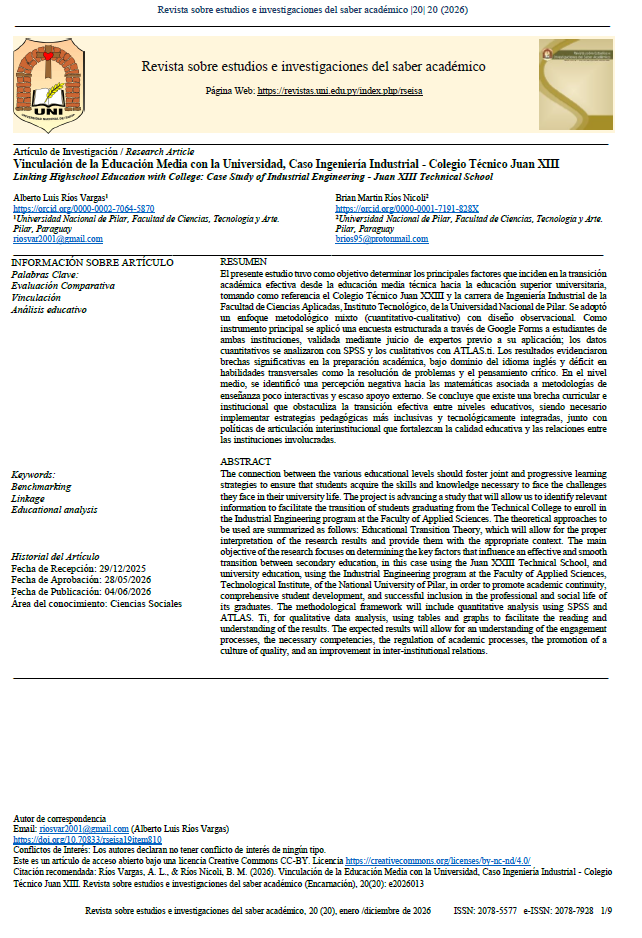
The connection between the various educational levels should foster joint and progressive learning strategies to ensure that students acquire the skills and knowledge necessary to face the challenges they face in their university life. The project is advancing a study that will allow us to identify relevant information to facilitate the transition of students graduating from the Technical College to enroll in the Industrial Engineering program at the Faculty of Applied Sciences. The theoretical approaches to be used are summarized as follows: Educational Transition Theory, which will allow for the proper interpretation of the research results and provide them with the appropriate context. The main objective of the research focuses on determining the key factors that influence an effective and smooth transition between secondary education, in this case using the Juan XXIII Technical School, and university education, using the Industrial Engineering program at the Faculty of Applied Sciences, Technological Institute, of the National University of Pilar, in order to promote academic continuity, comprehensive student development, and successful inclusion in the professional and social life of its graduates. The methodological framework will include quantitative analysis using SPSS and ATLAS. Ti, for qualitative data analysis, using tables and graphs to facilitate the reading and understanding of the results. The expected results will allow for an understanding of the engagement processes, the necessary competencies, the regulation of academic processes, the promotion of a culture of quality, and an improvement in inter-institutional relations.
Downloads
References
Agencia Nacional de Evaluación de la Calidad y Acreditación (s.f.). Guía de apoyo para la redacción, puesta en práctica y evaluación de los Resultados de Aprendizaje. http://www.aneca.es/Documentos-y-publicaciones/Otras-guias-y-documentos-deevaluacion/Guia-de-apoyo-para-la-redaccion-puesta-en-practica-y-evaluacion-de-losRESULTADOS-DEL-APRENDIZAJE
Azorín Abellán, C. (2019). LAS TRANSICIONES EDUCATIVAS Y SU INFLUENCIA EN EL ALUMNADO. Edetania. Estudios Y Propuestas Socioeducativos., (55), 223–248. https://doi.org/10.46583/edetania_2019.55.444
Boaler, J. (2016). Mathematical Mindsets.
Dweck, C. (2006). Mindset: The New Psychology of Success.
Herrera-Kit, P. Balanzó Guzmán, A., Parra Moreno, J. & Rivera, M. (2021). Mecanismos de colaboración interinstitucional: prácticas típicas. Innovar, 31(79), 135-149. https://doi.org/10.15446/innovar.v31n79.91888
Ramírez-Díaz, J. L. (2020). El enfoque por competencias y su relevancia en la actualidad: Consideraciones desde la orientación ocupacional en contextos educativos. Revista Electrónica Educare, 24(2). https://doi.org/10.15359/ree.24-2.23
Venegas Traverso, C. (2022). Bases para un Modelo de Articulación Curricular en la Escuela de Educación, en el Contexto del Currículum Mayor. RIIDEI – Revista de Innovación e Investigación para la Docencia en Educación Inicial, 3, 135. https://repositorio.umayor.cl/xmlui/bitstream/handle/sibum/8845/P%C3%A1ginas%20desdeRIIDEI%203%202022_pag%20135.pdf
Viera Torres, T. (2003). El Aprendizaje verbal significativo de Ausubel. Algunas consideraciones desde el enfoque cultural. Revista Universidades, (26), 37-43)
OECD (2018). PISA Results: Insights and Interpretations.
Downloads
Published
License
Copyright (c) 2026 Brian Martin Rios Nicoli, Alberto Rios

This work is licensed under a Creative Commons Attribution 4.0 International License.
Creative Commons Attribution License CC-BY
You are free to:
Share — copy and redistribute the material in any medium or format.
Adapt — remix, transform, and build upon the material for any purpose, including commercially.
Under the following terms:
Attribution — You must give appropriate credit, provide a link to the license, and indicate if any changes have been made. You may do so in any reasonable way, but not in any way that suggests that you or your use is endorsed by the Licensor.