Pet Ownership and Emotional Well-Being in Medical Students
DOI:
https://doi.org/10.70833/rseisa20item801Keywords:
Mental Health., Psychological Stress, Human-Animal Bond, Medical Education, AnxietyAbstract
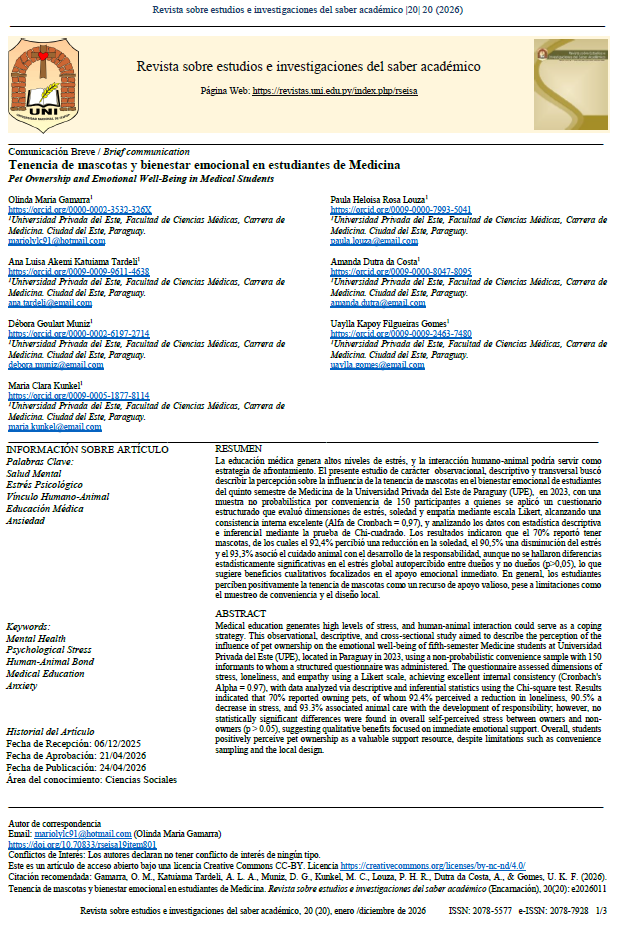
Medical education generates high levels of stress, and human-animal interaction could serve as a coping strategy. This observational, descriptive, and cross-sectional study aimed to describe the perception of the influence of pet ownership on the emotional well-being of fifth-semester Medicine students at Universidad Privada del Este (UPE), located in Paraguay in 2023, using a non-probabilistic convenience sample with 150 informants to whom a structured questionnaire was administered. The questionnaire assessed dimensions of stress, loneliness, and empathy using a Likert scale, achieving excellent internal consistency (Cronbach's Alpha = 0.97), with data analyzed via descriptive and inferential statistics using the Chi-square test. Results indicated that 70% reported owning pets, of whom 92.4% perceived a reduction in loneliness, 90.5% a decrease in stress, and 93.3% associated animal care with the development of responsibility; however, no statistically significant differences were found in overall self-perceived stress between owners and non-owners (p > 0.05), suggesting qualitative benefits focused on immediate emotional support. Overall, students positively perceive pet ownership as a valuable support resource, despite limitations such as convenience sampling and the local design.
Downloads
References
Andriacchi, M., Hopper, C., Stein, A., Nye, R., & Taylor, K. H. (2023). Animal-Assisted
Interventions on a College Campus to Improve Wellness: Adventures With the Northern
Michigan University Wildpups. Journal of Nursing Education, 62(11), 631-637.
https://doi.org/10.3928/01484834-20230906-05
Applebaum, J. W., Tomlinson, C. A., Matijczak, A., McDonald, S. E., & Zsembik, B. A. (2020). The
Concerns, Difficulties, and Stressors of Caring for Pets During COVID-19: Results From a
Large Survey of U.S. Pet Owners. Animals, 10(10), 1882. https://doi.org/10.3390/ani10101882
Brooks, H., Rushton, K., Lovell, K., Bee, P., Walker, L., Grant, L., & Rogers, A. (2018). The Power
of Support From Companion Animals for People Living With Mental Health Problems: A Systematic Review and Narrative Synthesis of the Evidence. BMC Psychiatry, 18(1). https://doi.org/10.1186/s12888-018-1613-2
Gee N.R., Rodriguez K.E., Fine A.H. and Trammell JP (2021) Dogs Supporting Human Health and
Well-Being: A Biopsychosocial Approach. Front. Vet. Sci. 8:630465. doi:
10.3389/fvets.2021.630465
Liu, H., Lin, J., & Lin, W. (2024). Cognitive Mechanisms and Neurological Foundations of
Companion Animals’ Role in Enhancing Human Psychological Well-Being. Frontiers in
Psychology, 15. https://doi.org/10.3389/fpsyg.2024.1354220
Oliveira, A. M. G., Andrade, B. L., Ferreira, G. C., Monteaperto, J. V. M., Perduca, R. G., Hungaro,
T. A., & Kurihara, A. C. Z. S. (2021). Prevalência da Síndrome de Burnout em estudantes da graduação de medicina. Revista Eletrônica Acervo Saúde, 13(2), e5047. https://doi.org/10.25248/reas.e5047.2021
Pendry, P., & Vandagriff, J. L. (2019). Animal Visitation Program (AVP) Reduces Cortisol Levels
of University Students: A Randomized Controlled Trial. Aera Open, 5(2). https://doi.org/10.1177/2332858419852592
Downloads
Published
License
Copyright (c) 2026 Olinda Maria Gamarra, Ana Luisa Akemi Katuiama Tardeli, Débora Goulart Muniz, Maria Clara Kunkel, Paula Heloisa Rosa Louza, Amanda Dutra da Costa, Uaylla Kapoy Filgueiras Gomes

This work is licensed under a Creative Commons Attribution 4.0 International License.
Creative Commons Attribution License CC-BY
You are free to:
Share — copy and redistribute the material in any medium or format.
Adapt — remix, transform, and build upon the material for any purpose, including commercially.
Under the following terms:
Attribution — You must give appropriate credit, provide a link to the license, and indicate if any changes have been made. You may do so in any reasonable way, but not in any way that suggests that you or your use is endorsed by the Licensor.