The Hybrid Classrooms: Expansion and Retention Strategy in University Programming
DOI:
https://doi.org/10.70833/rseisa20item769Keywords:
Hybrid Classrooms, Academic Performance, Student Retention, Programming, Educational TechnologyAbstract
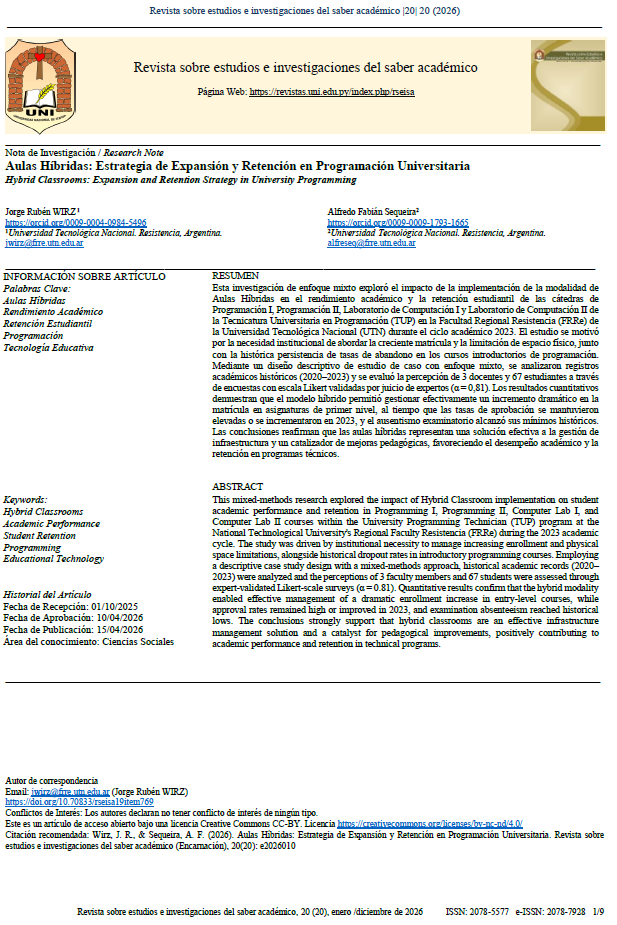
This mixed-methods research explored the impact of Hybrid Classroom implementation on student academic performance and retention in Programming I, Programming II, Computer Lab I, and Computer Lab II courses within the University Programming Technician (TUP) program at the National Technological University's Regional Faculty Resistencia (FRRe) during the 2023 academic cycle. The study was driven by institutional necessity to manage increasing enrollment and physical space limitations, alongside historical dropout rates in introductory programming courses. Employing a descriptive case study design with a mixed-methods approach, historical academic records (2020–2023) were analyzed and the perceptions of 3 faculty members and 67 students were assessed through expert-validated Likert-scale surveys (α = 0.81). Quantitative results confirm that the hybrid modality enabled effective management of a dramatic enrollment increase in entry-level courses, while approval rates remained high or improved in 2023, and examination absenteeism reached historical lows. The conclusions strongly support that hybrid classrooms are an effective infrastructure management solution and a catalyst for pedagogical improvements, positively contributing to academic performance and retention in technical programs.
Downloads
References
Alducin-Ochoa, J. M., & Vázquez-Martínez, A. I. (2016). Academic performance in blended-learning and face-toface university teaching. Píxel-BIT. Revista de Medios y Educación, (49), 157–170.
https://www.researchgate.net/publication/295848301
Álvarez-Chaves, A., & Saborío-Taylor, S. (2025). Hybrid learning in higher education: Considerations for its implementation in course design. Journal of Distance Education Technologies, 23(1). https://www.jdet.net/download/hybrid-learning-in-higher-education-considerations-for-its-implementationin-course-design-15859.pdf
Anjum, R., Zaheer Ali, N., Sarwar, U., Khalil, A., Irfan, N., & Anees, S. (2024). The impact of remote and hybrid learning models on student engagement and academic performance at university level. Remittances Review, 9(S1). https://remittancesreview.com/menu-script/index.php/remittances/article/view/1936
Arias Ortiz, E., Giambruno, C., Morduchowicz, A., & Pineda, B. (2024). El estado de la educación en América Latina y el Caribe 2023. Banco Interamericano de Desarrollo. https://doi.org/10.18235/0005515
Bakar, E. E. A., Halim, N. D. A., & Hanid, M. F. A. (2024). Integrating blended learning in programming course: A systematic review. Quarterly Journal of Social Sciences and Humanities, 5(2), 1–15.
https://www.qjssh.com/index.php/qjssh/article/download/566/313
Creswell, J. W., & Plano Clark, V. L. (2018). Designing and conducting mixed methods research (3rd ed.). SAGE Publications.
Fernández-Cando, D., Mogollón-Gutiérrez, G., Chango-Muñoz, B., & Espinoza-Alvarado, G. (2024). Educación híbrida: impacto en el aprendizaje y adaptación de los estudiantes. MQRInvestigar, 8(3), 1–18. https://www.investigarmqr.com/ojs/index.php/mqr/article/download/1538/5054/6067
Garia-Escudero, H. (2023, octubre 9). Is the flipped classroom model suitable for coding courses? UCI Division of Teaching Excellence and Innovation. https://dtei.uci.edu/2023/10/09/is-the-flipped-classroom-modelsuitable-for-coding-courses/
George, D., & Mallery, P. (2003). SPSS for Windows step by step: A simple guide and reference (4th ed.). Allyn & Bacon.
Gudoniene, D., Staneviciene, E., Huet, I., Dickel, J., Djibril, D., Degroote, J., Vitor, R., Butkiene, R., & Casanova,
D. (2025). Hybrid teaching and learning in higher education: A systematic literature review. Sustainability, 17(2), 756. https://doi.org/10.3390/su17020756
Hellas, A. (2017). Retention in introductory programming. CORE. https://core.ac.uk/download/132490503.pdf
Parks, R., Childs, K., & Nuzzo, R. (2020). The impact of remote and hybrid learning models on student engagement and academic performance at university level. Educational Research Review, 31, 100357. https://doi.org/10.1016/j.edurev.2020.100357
Pillajo-Pila, K., Cueva-Cabrera, C., Guaygua-Amaguaña, M., & Toapanta-Toapanta, L. (2025). El impacto del aprendizaje híbrido en estudiantes universitarios en el siglo XXI: efectividad, beneficios y desafíos en
América Latina. Revista Latinoamericana de Tecnología Educativa, 24(1). https://doi.org/10.56712/latam.v6i1.3381
Safla, A., Suleman, H., & Gain, J. (2024). Transitioning an introductory programming course into a blended learning format. En H. E. Van Rensburg, M. M. Sikhosana, & G. Obaido (Eds.), ICT Education. SACLA 2023. Communications in Computer and Information Science (Vol. 1862, pp. 85–100). Springer. https://doi.org/10.1007/978-3-031-48536-7_6
Wirz, J. R. (2025). Impacto de aulas híbridas en rendimiento académico y retención de estudiantes de Programación y Laboratorio de Computación de TUP en FRRe durante ciclo 2023 [Tesis de Licenciatura en Tecnología Educativa]. Universidad Tecnológica Nacional, Facultad Regional Resistencia.
Yin, R. K. (2018). Case study research and design methods (6th ed.). SAGE Publications.
Downloads
Published
License
Copyright (c) 2026 Jorge Ruben Wirz, Alfredo Fabián Sequeira

This work is licensed under a Creative Commons Attribution 4.0 International License.
Creative Commons Attribution License CC-BY
You are free to:
Share — copy and redistribute the material in any medium or format.
Adapt — remix, transform, and build upon the material for any purpose, including commercially.
Under the following terms:
Attribution — You must give appropriate credit, provide a link to the license, and indicate if any changes have been made. You may do so in any reasonable way, but not in any way that suggests that you or your use is endorsed by the Licensor.