Free-Range Poultry Systems for Sustainable Production in Rural Territories
DOI:
https://doi.org/10.70833/rseisa20item749Keywords:
free-range, animal welfare, agroecology, poultry farming, territorial sustainability.Abstract
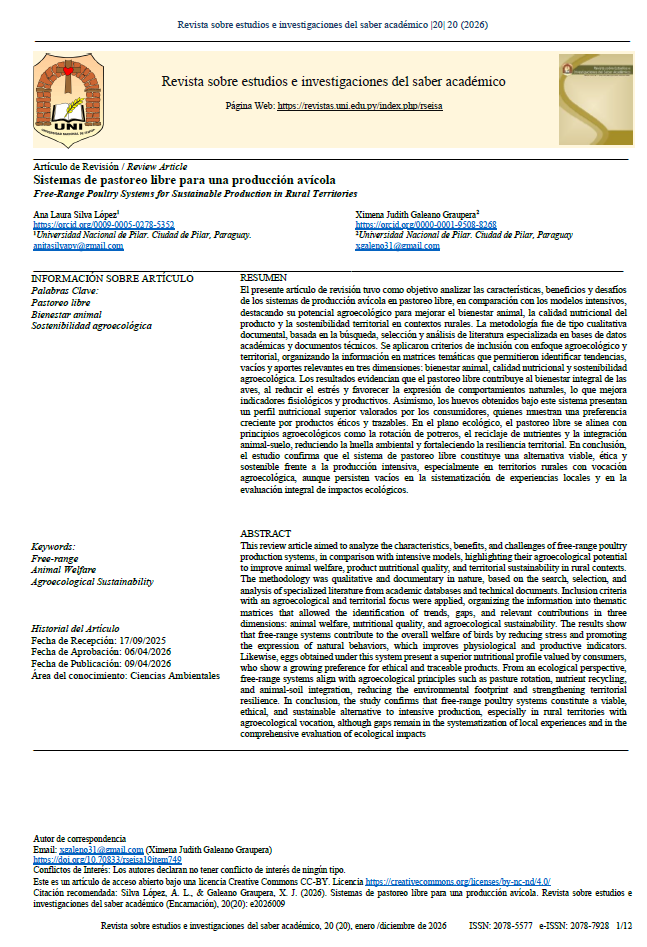
This review article aimed to analyze the characteristics, benefits, and challenges of free-range poultry production systems, in comparison with intensive models, highlighting their agroecological potential to improve animal welfare, product nutritional quality, and territorial sustainability in rural contexts. The methodology was qualitative and documentary in nature, based on the search, selection, and analysis of specialized literature from academic databases and technical documents. Inclusion criteria with an agroecological and territorial focus were applied, organizing the information into thematic matrices that allowed the identification of trends, gaps, and relevant contributions in three dimensions: animal welfare, nutritional quality, and agroecological sustainability. The results show that free-range systems contribute to the overall welfare of birds by reducing stress and promoting the expression of natural behaviors, which improves physiological and productive indicators. Likewise, eggs obtained under this system present a superior nutritional profile valued by consumers, who show a growing preference for ethical and traceable products. From an ecological perspective, free-range systems align with agroecological principles such as pasture rotation, nutrient recycling, and animal-soil integration, reducing the environmental footprint and strengthening territorial resilience. In conclusion, the study confirms that free-range poultry systems constitute a viable, ethical, and sustainable alternative to intensive production, especially in rural territories with agroecological vocation, although gaps remain in the systematization of local experiences and in the comprehensive evaluation of ecological impacts
Downloads
References
Altieri, M. A., & Nicholls, C. I. (2017). Agroecology: A brief account of its origins and currents of
thought in Latin America. Agroecology and Sustainable Food Systems, 41(3–4), 231–237. https://doi.org/10.1080/21683565.2017.1287147
Anderson, K. E. (2011). Comparison of fatty acid, cholesterol, and vitamin A and E composition in eggs from hens housed in conventional cage and range production systems. International Journal of Poultry Science, 10(5), 350–354. https://doi.org/10.3382/ps.2010-01289
Asociación de Avicultores del Paraguay (AVIPAR). (s.f.). Consumo per cápita. Recuperado de
https://avipar.org.py/consumo-per-capita
Asociación Rural del Paraguay (ARP). (2021). Crecimiento de las exportaciones fue lo destacado en un complicado año avícola. Recuperado de https://www.arp.org.py/index.php?option=com_content&view=article&id=3283:crecimiento-de-las-exportaciones-fue-lo-destacado-en-un-complicado-ano-avicola&catid=16&Itemid=116
Barajas Maldonado, L. (2019). Indicadores fisiológicos en gallinas de pastoreo libre. Revista Avícola Experimental, 18(2), 45–59.
Blokhuis, H. J. (Coord.). (2019). Assessment protocol for laying hens. Welfare Quality Network. https://www.welfarequalitynetwork.net/media/1294/wq_laying_hen_protocol_20_def-december-2019.pdf
Buitrago, J., & Forero, M. (2016). Avicultura ética y percepción del consumidor. Ciencia Avícola, 32(1), 45–58.
Campbell, D. L. M., Hinch, G. N., Downing, J. A., & Lee, C. (2017). Outdoor stocking density in free-range laying hens: Effects on behaviour and welfare. Animal, 11(6), 1036–1045. https://doi.org/10.1017/S1751731116002342
Council Directive 1999/74/EC. (1999). Laying down minimum standards for the protection of laying hens. Official Journal of the European Communities, L203, 53–57. https://www.ecolex.org/es/details/legislation/council-directive-199974ec-laying-down-minimum-standards-for-the-protection-of-laying-hens-lex-faoc034973/?page=9401
Cuéllar, M. (2021). Informe técnico sobre comportamiento natural en sistemas avícolas. Instituto Nacional de Producción Animal.
Demanet Filippi, R. (2020). Etología aplicada al manejo avícola. Universidad de La Frontera.
Duarte, M. (2025, marzo 21). Radiografía del sector avícola: estos son los principales números detrás de uno de los pilares de la industria nacional. Forbes Paraguay. Recuperado de https://www.forbes.com.py/negocios/radiografia-sector-avicola-estos-son-principales-numeros-detras-uno-pilares-industria-nacional-n69401
Fanatico, A. C., Born, H., & Alley, A. (2006). Poultry house management for alternative production. National Center for Appropriate Technology (NCAT). http://www.agropustaka.id/wp-content/uploads/2020/04/agropustaka.id_buku_Poultry-Health-and-Management-Chicken-Turkey-Ducks-Geese-and-Quail.pdf
Flores Arévalo, C. A. (2025). Percepción de calidad y trazabilidad en productos avícolas. APA.org.es.
Gómez, M., & Castañeda, R. (2022). Evaluación comparativa de sistemas avícolas: jaula, piso y pastoreo libre. Organitec.
González, H., Solís, D., Esteche, G., & Gómez, G. (2022). Estrategia nacional para el fomento de la producción orgánica y agroecológica en el Paraguay. Ministerio de Agricultura y Ganadería, ALTER VIDA, & Instituto Interamericano de Cooperación para la Agricultura (IICA).
Hartcher, K. M., & Jones, B. (2017). The welfare of layer hens in cage and cage-free housing systems. World's Poultry Science Journal, 73(4), 767–782. https://doi.org/10.1017/S0043933917000812
Instituto Interamericano de Cooperación para la Agricultura. (2022). Estrategia nacional para el fomento de la producción orgánica y agroecológica en el Paraguay: Alternativa de crecimiento socioeconómico y sostenibilidad ambiental. Asunción: MAG/IICA
Karsten, H. D., Patterson, P. H., Stout, R., & Crews, G. (2010). Vitamins A and E, and fatty acid composition of eggs from hens housed in conventional cage and pasture systems. Poultry.
Lay, D. C., Jr., Fulton, R. M., Hester, P. Y., Karcher, D. M., Kjaer, J. B., Mench, J. A., Mullens, B. A., Newberry, R. C., Nicol, C. J., O’Sullivan, N. P., & Porter, R. E. (2011). Hen welfare in different housing systems. Poultry Science, 90(1), 278–294. https://doi.org/10.3382/ps.2010-00962
Science, 89(8), 1606–1612. https://www.cambridge.org/core/journals/renewable-agriculture-and-food-systems/article/abs/vitamins-a-e-and-fatty-acid-composition-of-the-eggs-of-caged-hens-and-pastured-hens/552BA04E5A9E3CD7E49E405B339ECA32
Madrigal-Portilla, J., Vargas, E., & Rojas, L. (2023). Calidad del huevo en sistemas de conservación y pastoreo. Nota técnica, Universidad Nacional.
Miao, Z., Glatz, P. C., & Ru, Y. (2018). Free-range poultry production: A review. Asian-
Australasian Journal of Animal Sciences, 28(6), 861–870. https://www.animbiosci.org/journal/view.php?doi=10.5713/ajas.2005.113
Ministerio de Agricultura y Ganadería. (2020). Compendio de Zonificación Agroecológica del Paraguay. Dirección de Planificación Agrícola.
Napolitano, F., Girolami, A., & Braghieri, A. (2013). Consumer liking and willingness to pay for high welfare animal-based products. Trends in Food Science & Technology, 29(2), 85–92. Napolitano, F., Girolami, A., & Braghieri, A. (2013). Consumer liking and willingness to pay for high welfare animal-based products. https://doi.org/10.1016/j.tifs.2010.07.012
Ochoa Moreno, D. A. (2001). Anotaciones sobre un sistema de producción avícola en pastoreo. Universidad Nacional de Colombia.
Ruiz Olabuénaga, J. I. (2012). Metodología de la investigación cualitativa. Ediciones Mensajero.
Saavedra-Mera, P. (2023). Bienestar animal en sistemas enriquecidos de pastoreo libre. Revisión científica, Universidad Técnica de Ambato.
Segovia, M., & Ortega, A. (2020). Agroecología y justicia territorial en América Latina. Revista de Estudios Rurales, 12(1), 45–62.
Soil Association. (2004). Manejo de gallinas ponedoras orgánicas. Guías técnicas de Soil Association.
Soler, J. (2010). Avicultura convencional y sus impactos ambientales. Editorial AgroSur.
Sossidou, E. N., Dal Bosco, A., Castellini, C., & Grashorn, M. A. (2015). Pasture-raised poultry:
Quality, welfare and consumer acceptance. World’s Poultry Science Journal, 71(4), 887–902. https://doi.org/10.1017/S0043933915000379
Secretaría Técnica de Planificación (STP). (2014). Plan Nacional de Desarrollo 2030. Gobierno de Paraguay.
Terranimal. (2024). Guía de bienestar animal para gallinas ponedoras en sistemas de libre pastoreo (2ª ed.). Fundación Terranimal.
Torres Aquino, L. (2024). Evaluación nutricional de huevos en gallinas Hy-Line Brown bajo pastoreo libre [Tesis de licenciatura, Universidad Nacional de Asunción].
Uzcátegui-Varela, M., Pérez, J., & León, A. (2019). Perfil nutricional de huevos en sistemas alternativos. Revista de Producción Animal, 27(3), 112–128.
Valles, M. S. (2000). Técnicas cualitativas de investigación social. Editorial Síntesis.
Vasilachis, I. (2006). Estrategias de investigación cualitativa. Editorial Gedisa.
Vega, A. (2024). Regeneración de suelos y biodiversidad en sistemas avícolas agroecológicos.
Documento técnico, Universidad Nacional de Itapúa.
WingChing-Jones, R., Ramírez, J., & Mora, A. (2023). Evaluación nutricional depastoreo libre. Revista Técnica Agroalimentaria, 39(2), 78–94.
Downloads
Published
License
Copyright (c) 2026 Ana Laura Silva López, Ximena Judith Galeano Graupera

This work is licensed under a Creative Commons Attribution 4.0 International License.
Creative Commons Attribution License CC-BY
You are free to:
Share — copy and redistribute the material in any medium or format.
Adapt — remix, transform, and build upon the material for any purpose, including commercially.
Under the following terms:
Attribution — You must give appropriate credit, provide a link to the license, and indicate if any changes have been made. You may do so in any reasonable way, but not in any way that suggests that you or your use is endorsed by the Licensor.