Evolution of accounting principles in the face of global technological and economic changes
DOI:
https://doi.org/10.70833/rseisa20item685Keywords:
Accounting, Artificial Intelligence, Blockchain, Intangible AssetsAbstract
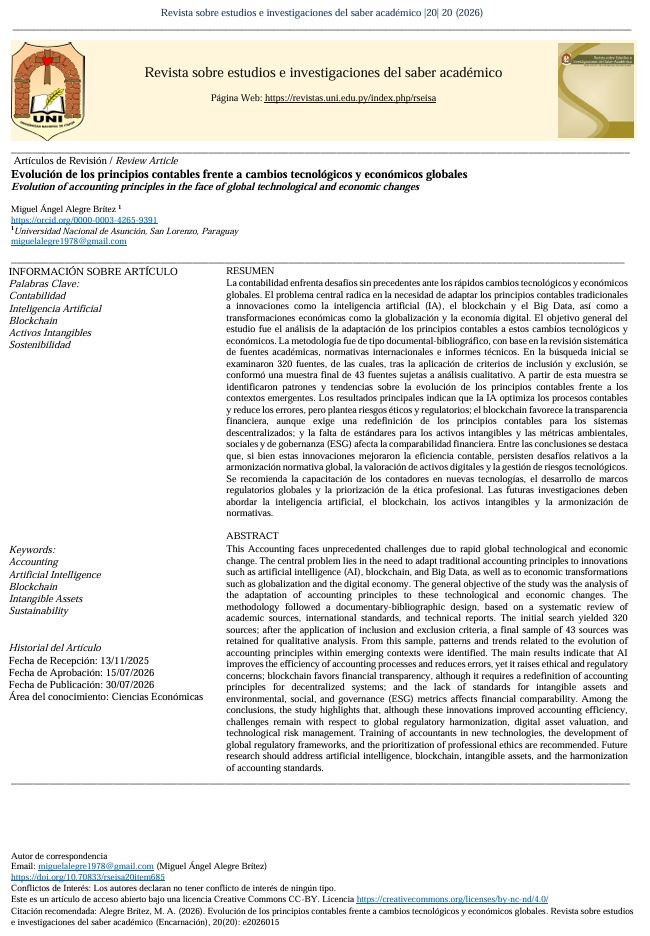
Accounting faces unprecedented challenges due to rapid global technological and economic change. The central problem lies in the need to adapt traditional accounting principles to innovations such as artificial intelligence (AI), blockchain, and Big Data, as well as to economic transformations such as globalization and the digital economy. The general objective of the study was the analysis of the adaptation of accounting principles to these technological and economic changes. The methodology followed a documentary-bibliographic design, based on a systematic review of academic sources, international standards, and technical reports. The initial search yielded 320 sources; after the application of inclusion and exclusion criteria, a final sample of 43 sources was retained for qualitative analysis. From this sample, patterns and trends related to the evolution of accounting principles within emerging contexts were identified. The main results indicate that AI improves the efficiency of accounting processes and reduces errors, yet it raises ethical and regulatory concerns; blockchain favors financial transparency, although it requires a redefinition of accounting principles for decentralized systems; and the lack of standards for intangible assets and environmental, social, and governance (ESG) metrics affects financial comparability. Among the conclusions, the study highlights that, although these innovations improved accounting efficiency, challenges remain with respect to global regulatory harmonization, digital asset valuation, and technological risk management. Training of accountants in new technologies, the development of global regulatory frameworks, and the prioritization of professional ethics are recommended. Future research should address artificial intelligence, blockchain, intangible assets, and the harmonization of accounting standards.
Downloads
References
Aldahray, A. (2024). Notes Readability and Discretionary Accruals. Revista de Contabilidad, 27(2), 229-238. https://doi.org/10.6018/rcsar.459281
Al-Shattarat, B. (2024). The influence of leverage on accrual-based and real earnings management: Evidence from the UK. Revista de Contabilidad, 27(2), 239-248. https://doi.org/10.6018/rcsar.499761
Anderson, S. B., Mendoza, K. I., & Mongold, C. (2025). The Effect of Intangible Asset Classification on Professional Financial Statement Users' Assessments. Journal of Accounting Research, 1475-679X.12604. https://doi.org/10.1111/1475-679X.12604
Annelin, A., & Svanström, T. (2024). Audit team diversity, work quality and affective state outcomes. International Journal of Auditing, ijau.12354. https://doi.org/10.1111/ijau.12354
Anzilago, M., & Lunkes, R. J. (2024). Efeito da colaboração na relação entre troca social e desenho do sistema de controle gerencial. Revista de Contabilidade e Organizações, 18, e219391. https://doi.org/10.11606/issn.1982-6486.rco.2024.219391
Ashraf, M., Donelson, D. C., McInnis, J., & Mergenthaler, R. D. (2025). Fair value accounting standards and securities litigation. Journal of Accounting and Economics, 79(1), 101705. https://doi.org/10.1016/j.jacceco.2024.101705
Barrainkua Aroztegi, I., Aldazabal Etxeberria, M. E., & Espinosa-Pike, M. (2024). Improving work outcomes in audit firms: The mediating role of perceived organizational support. Revista de Contabilidad, 27(2), 331-343. https://doi.org/10.6018/rcsar.529101
Chakrabarty, B., Hyman, M., & Krishnan, G. V. (2024). Audit outcomes of non‐financial misconduct. International Journal of Auditing, ijau.12347. https://doi.org/10.1111/ijau.12347
Chau, J. (2025). Accounting Information Usage and Trading by Retail Investors: Evidence from Integrated Trading Platform. Journal of Accounting Research, 1475-679X.12606. https://doi.org/10.1111/1475-679X.12606
Cuny, C., Mehta, M. N., & Zhao, W. (2025). Limits to Political Capture: Evidence from Patent Grants, Disclosures, and Litigation. Journal of Accounting Research, 1475-679X.12607. https://doi.org/10.1111/1475-679X.12607
Garmendia-Lazcano, A., & Baselga-Pascual, L. (2025). The role of regional tax autonomy, firm size, and business groups in tax avoidance: Evidence from Spain. Spanish Journal of Finance and Accounting / Revista Española de Financiación y Contabilidad, 54(1), 23-56. https://doi.org/10.1080/02102412.2024.2377448
Giner, B., Merello, P., Nakamura, M., & Pardo, F. (2025). The role of institutional isomorphism in explaining the voluntary IFRS adoption. Revista de Contabilidad, 28(1), 18-31. https://doi.org/10.6018/rcsar.508231
Gisbert, A., Navallas, B., Gómez-Carrasco, P., & De Las Heras, E. (2025). Implications of the EU Regulation on Public Oversight Systems for Statutory Auditors. Revista de Contabilidad, 28(1), 133-150. https://doi.org/10.6018/rcsar.483841
González-Morales, M., Cavero-Rubio, J. A., & Amorós-Martínez, A. (2025). The role of political foundations in the bank indebtedness of political parties: The case of Spain. Spanish Journal of Finance and Accounting / Revista Española de Financiación y Contabilidad, 54(1), 1-22. https://doi.org/10.1080/02102412.2024.2365533
Gunardi, A., Badavath, S., & Mathur, S. (2025). Evaluating the moderating effect of online shopping attitude on online impulsive shopping; A study of Indian emerging market shoppers. Contaduría y Administración, 70(3), 505. https://doi.org/10.22201/fca.24488410e.2025.5023
Hancu-Budui, A., & Zorio-Grima, A. (2024). New Public Governance and Public Value Co-creation: The Case of the European Court of Auditors Environmental Audits. Revista de Contabilidad, 27(2), 275-287. https://doi.org/10.6018/rcsar.519241
Hayes, R. M., Jiang, F., Pan, Y., & Tang, H. (2025). Racial Disparities in Financial Complaints and the Role of Corporate Social Attitudes. Journal of Accounting Research, 1475-679X.12612. https://doi.org/10.1111/1475-679X.12612
Isack, M., & Aschauer, E. (2024). The Role of CSR Report Assurance and ESG Rating in Bank Manager's Judgement on ESG Lending Decisions. International Journal of Auditing. https://doi.org/10.1111/ijau.12369
Kang, Y. (2025). Financial Reporting Around Private Firms' Securities Offerings. Journal of Accounting Research, 1475-679X.12598. https://doi.org/10.1111/1475-679X.12598
Kazim, I., Wang, F., Nie, D., & Jameel Hussain, M. (2025). Can more able CEOs reduce the gap between internal and external CSR disclosures? Revista de Contabilidad, 28(1), 84-95. https://doi.org/10.6018/rcsar.557871
Kim, S., Kim, J., & Lee, H. (2025). The Effect of Earlier Contract Date for Auditor Change on Audit Quality. International Journal of Auditing. https://doi.org/10.1111/ijau.12371
Klann, R. C., & Giordani, M. D. S. (2024). Uso de mídia social pelo CEO e a relevância da informação contábil. Revista de Contabilidade e Organizações, 18, e224767. https://doi.org/10.11606/issn.1982-6486.rco.2024.224767
Lee, J., Jung, S., & Cho, H. (2025). Managerial ability and tax avoidance adjustment toward the optimal level. Spanish Journal of Finance and Accounting / Revista Española de Financiación y Contabilidad, 54(1), 57-85. https://doi.org/10.1080/02102412.2024.2380954
Lejárraga García, A., Ortiz Martínez, E., & Marín Hernández, S. (2024). Sustainability in the Waste Management Sector: An Analysis through the GRI Reports. Revista de Contabilidad, 27(2), 307-322. https://doi.org/10.6018/rcsar.530451
Li, B., & Wang, A. Y. (2024). On the EPA's Radar: The Role of Financial Reports in Environmental Regulatory Oversight. Journal of Accounting Research, 62(5), 1849-1900. https://doi.org/10.1111/1475-679X.12572
Lu, Y. (2025). The Spillover Effect of Liquidity Transparency on Liquidity Holdings. Journal of Accounting Research, 1475-679X.12602. https://doi.org/10.1111/1475-679X.12602
Monterrey Mayoral, J., & Rabazo Martín, A.-E. (2025). How are accounting irregularities examined in Spanish insolvency proceedings? An empirical analysis. Revista de Contabilidad, 28(1), 151-164. https://doi.org/10.6018/rcsar.577941
Navarro-Galera, A., Gómez-Miranda, M. E., Lara-Rubio, J., & Buendía-Carrillo, D. (2024). Empirical research to identify early warning indicators of insolvency in small and medium-sized enterprises (SMEs). Revista de Contabilidad, 27(2), 344-356. https://doi.org/10.6018/rcsar.554181
Ndlovu, M. O., & Schutte, D. P. (2024). An evaluation of tax compliance among small businesses. South African Journal of Accounting Research, 1-19. https://doi.org/10.1080/10291954.2024.2372132
Nogueira, S. P. D. S., & Jorge, S. M. (2024). Perspectivas sobre o uso da informação financeira pública pelos políticos: Resultados recentes e desafios futuros. Revista de Contabilidade e Organizações, 18, e227514. https://doi.org/10.11606/issn.1982-6486.rco.2024.227514
Quick, R., & Yalçin, N. (2024). The Impact of Combating Bribery and Corruption Report Assurance on Financial Analysts' Decisions. International Journal of Auditing. https://doi.org/10.1111/ijau.12370
Ru, Y., Zheng, R., & Zou, Y. (2025). Public Disclosure of Private Meetings: Does Observing Peers' Information Acquisition Affect Analysts' Attention Allocation? Journal of Accounting Research, 1475-679X.12603. https://doi.org/10.1111/1475-679X.12603
Ruiz-Barbadillo, E., Martinez-Conesa, I., Serrano-Madrid, J., & Brown-Liburd, H. (2024). Audit Risk Management and Audit Effort in Small and Medium Audit Firms. Revista de Contabilidad, 27(2), 212-228. https://doi.org/10.6018/rcsar.462211
Schoeman, A. (2024). An exploratory study on supplier acceptance of and engagement in a national tax lottery designed to improve tax compliance. South African Journal of Accounting Research, 1-21. https://doi.org/10.1080/10291954.2024.2393913
Ştefănescu, C. A. (2025). Towards a conceptualised belief-action-outcome model for enhanced non-financial reporting: A systematic and integrative review. Revista de Contabilidad, 28(1), 115-132. https://doi.org/10.6018/rcsar.568861
Stein, E., & Cunha, P. R. D. (2024). Professional skepticism of internal auditors and perception of risks in internal controls. Revista Contabilidade & Finanças, 35(96), e1922. https://doi.org/10.1590/1808-057x20241922.en
Ucieda Blanco, J. L., Santos Cabalgante, B., & Romero Fúnez, D. (2025). The Role and Characteristics of National Accounting Standard Setters in the European Union: A Comparative Analysis. Revista de Contabilidad, 28(1), 165-179. https://doi.org/10.6018/rcsar.437971
Urdaneta Camacho, R., Guevara Pérez, J. C., Martín Vallespín, E., & Llena Macarulla, F. (2025). 'Creative accounting' in the Spanish professional football League: An attempt to dodge the rules economic control? Revista de Contabilidad, 28(1), 180-192. https://doi.org/10.6018/rcsar.553911
Vázquez Oteo, O., Garcia-Torea, N., & De La Cuesta-González, M. (2025). Corporate corruption management: A proposal for an accountability framework. Revista de Contabilidad, 28(1), 96-114. https://doi.org/10.6018/rcsar.543701
Venturini, L. D. B., Gama, S. D., & Marques, V. A. (2024). Relação dos principais assuntos de auditoria e o audit delay com a reapresentação das demonstrações financeiras. Revista de Contabilidade e Organizações, 18, e227391. https://doi.org/10.11606/issn.1982-6486.rco.2024.227391
Wu, S., Zhu, J., & Wu, T. (2025). The impact of CEO founder and CEO age on new ventures performance: A quantile regression analysis for U.S. IPOs. Revista de Contabilidad, 28(1), 3-17. https://doi.org/10.6018/rcsar.553941
Yang, L., & Yang, P. (2024). Market conditions, investor sentiment and disposition effect. An empirical study based on China's stock market. Revista de Contabilidad, 27(2), 260-274. https://doi.org/10.6018/rcsar.529401
Downloads
Published
License
Copyright (c) 2026 Miguel Alegre

This work is licensed under a Creative Commons Attribution 4.0 International License.
Creative Commons Attribution License CC-BY
You are free to:
Share — copy and redistribute the material in any medium or format.
Adapt — remix, transform, and build upon the material for any purpose, including commercially.
Under the following terms:
Attribution — You must give appropriate credit, provide a link to the license, and indicate if any changes have been made. You may do so in any reasonable way, but not in any way that suggests that you or your use is endorsed by the Licensor.