Impact of Citizen Attitudes on the Socio-Environmental Management of the Coastal Defense
DOI:
https://doi.org/10.70833/rseisa20item725Keywords:
Citizen attitudes, Socio-environmental management, Coastal defense, Community resilienceAbstract
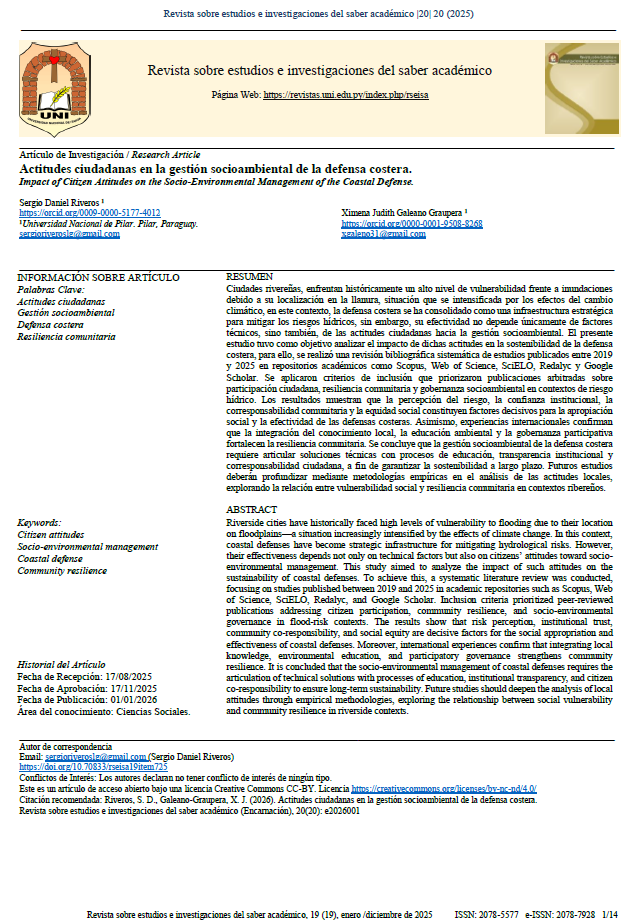
Riverside cities have historically faced high levels of vulnerability to flooding due to their location on floodplains—a situation increasingly intensified by the effects of climate change. In this context, coastal defenses have become strategic infrastructure for mitigating hydrological risks. However, their effectiveness depends not only on technical factors but also on citizens’ attitudes toward socio-environmental management. This study aimed to analyze the impact of such attitudes on the sustainability of coastal defenses. To achieve this, a systematic literature review was conducted, focusing on studies published between 2019 and 2025 in academic repositories such as Scopus, Web of Science, SciELO, Redalyc, and Google Scholar. Inclusion criteria prioritized peer-reviewed publications addressing citizen participation, community resilience, and socio-environmental governance in flood-risk contexts. The results show that risk perception, institutional trust, community co-responsibility, and social equity are decisive factors for the social appropriation and effectiveness of coastal defenses. Moreover, international experiences confirm that integrating local knowledge, environmental education, and participatory governance strengthens community resilience. It is concluded that the socio-environmental management of coastal defenses requires the articulation of technical solutions with processes of education, institutional transparency, and citizen co-responsibility to ensure long-term sustainability. Future studies should deepen the analysis of local attitudes through empirical methodologies, exploring the relationship between social vulnerability and community resilience in riverside contexts.
Downloads
References
Ajibade, I. (2020). The resilience fix to climate disasters: Recursive and contested relations with equity- and justice-based transformations in the Global South. Annals of the American Association of Geographers, 112(8). https://doi.org/10.1080/24694452.2022.2062290
Ajzen, I. (1991). The theory of planned behavior. Organizational Behavior and Human Decision Processes. ScienceDirect, 50(2), 179-211. https://doi.org/10.1016/0749-5978(91)90020-T
Alam, E., Ray-Bennett, N. (2021). Disaster risk reduction and gender: The case of Bangladesh. International Journal of Disaster Risk Reduction. Elsevier, 59, 1-13. https://doi.org/10.1016/j.ijdrr.2021.102220
Banco Mundial. (2020). El Servicio de Agua y Saneamiento en Paraguay Análisis sobre aspectos institucionales, de gobernanza y sobre el gasto público. https://documents1.worldbank.org/curated/en/394511602832678908/pdf/El-Servicio-de-Agua-y-Saneamiento-en-Paraguay-An%C3%A1lisis-Sobre-Aspectos-Institucionales-de-Gobernanza-y-Sobre-el-Gasto-P%C3%BAblico.pdf
Botzen, W. J. W., Kunreuther, H., Michel-Kerjan, E. O. (2019). Protecting against disaster risks: Why insurance and prevention may be complements. Journal of Risk and Uncertainty, 59(2), 151-169. https://doi.org/10.1007/s11166-019-09312-6
Braun, V., Clarke, C. (2006). Using thematic analysis in psychology. Qualitative Research in Psychology, 3(2), 77-101. https://www.researchgate.net/publication/235356393_Using_thematic_analysis_in_psychology
Brereton, P., Kitchenham, D. B., Turner, M., Khalil, M. (2007). Lessons from applying the systematic literature review process within the software engineering domain. ELSEVIER, 80(4), 571-583. https://doi.org/10.1016/j.jss.2006.07.009
Castañeda Torres, S., Rodríguez Miranda, J. P. (2019). Análisis bibliométrico e implementación de las herramientas del sistema de gestión ambiental en América Latina (2010–2018). Revista Espacios, 40(7), 1-14. https://www.revistaespacios.com/a19v40n07/a19v40n07p18.pdf
Castro-Díaz, R., Visintini, M. L., del Rey Rodríguez, M., Bustamante, M. B., Medrano, M. A., Müller Heidenreich, M., Natenzon, C. (2025). Vulnerabilidad social y análisis hemerográfico de los desastres hidrológicos en la provincia de Entre Ríos, Argentina (2000-2020). REDER, 9(2). https://www.revistareder.com/ojs/index.php/reder/article/view/193
Consultora – TRM SRL. (2020). DIAGNÓSTICO URBANO Y RECOMENDACIONES DE DESARROLLO Y ORDENAMIENTO TERRITORIAL PARA LA CIUDAD DE PILAR (p. 70). https://pilar.gov.py/wp-content/uploads/2022/03/EDU-Defensa-Costera-de-Pilar.pdf
Corbin, J., Strauss, A. (2012). Basics of Qualitative Research (3rd ed.): Techniques and Procedures for Developing Grounded Theory. SAGE Publications, Inc. https://click.endnote.com/viewer?doi=10.4135%2F9781452230153&token=WzM1NDcxNzgsIjEwLjQxMzUvOTc4MTQ1MjIzMDE1MyJd.jxLFNaWeiq2QUJQgsrG07j0h5MI
Córdova,Aguilar, H. (2020). Vulnerabilidad y gestión del riesgo de desastres frente al cambio climático en el noroeste peruano: El caso de Piura. Revista de Geografía, 29(1), 85-104. https://doi.org/10.22395/seec.v23n54a5
Farinós, J. (coord). (2011). La gestión integrada de zonas costeras, ¿algo más que una ordenación litoral revisada? La GIZC como evolución de las prácticas de planificación y gobernanza territoriales. Universidad de Valencia.
Hegger, D., Driessen, P., Dieperink, C., Wiering, M., Raadgever, T., van Rijswick, M. (2013). STAR-FLOOD: Towards appropriate and resilient flood risk governance arrangements. ICFR-Universiteit Utrecht. https://dspace.library.uu.nl/handle/1874/314882
Howe, P. D., Marlon, J. R., Mildenberger, M., Shield, B. S. (2019). How will climate change shape climate opinion? Eviron.Res.Lett, 14, 1-17. https://doi.org/10.1088/1748-9326/ab466a
Kammila, S. (2024, noviembre 6). El Sur Global ha impulsado la adaptación climática liderada a nivel local. Es momento de llevarla a mayor escala. [Entrevista]. https://climatepromise.undp.org/es/news-and-stories/sur-global-adaptacion-climatica-liderada-nivel-local-mayor-escala
Kitchenham, B., Charters (2007). Guidelines for performing systematic literature reviews in software engineering. Keele University & University of Durham. https://legacyfileshare.elsevier.com/promis_misc/525444systematicreviewsguide.pdf
Leff, E. (2004). RACIONALIDAD AMBIENTAL La reapropiación social de la naturaleza. Siglo XXI. https://ru.iis.sociales.unam.mx/bitstream/IIS/4937/1/Racionalidad_ambiental.pdf
Marín, A. (2025). Participación ciudadana en la gestión de los recursos naturales y la transformación territorial sostenible. CEPAL- SERIE 25-DESARROLLO TERRITORIAL, 53. https://repositorio.cepal.org/server/api/core/bitstreams/7ceafaf1-0bfd-4ddf-826e-62797713606b/content
Mees, H., Tempels, B., Crabbé, A., Boelens, Luuk. (2016). Shifting public-private responsibilities in Flemish flood risk management. Towards a co-evolutionary approach. ELSEVIR, 57, 23-33. https://doi.org/10.1016/j.landusepol.2016.05.012
Merlysky, M. G., Tobias, M. A. (2016). Inundaciones y construcción social del riesgo en Buenos Aires Acciones colectivas, controversias y escenarios de futuro. CUADERNOS DEL CENDES, 33(91), 45-63. https://ve.scielo.org/pdf/cdc/v33n91/art04.pdf
Navarro, O., Chaves-Castaño, L., Noreña Betancur, M. I., Piñeres-Sus, J. D. (2016). PERCEPCIÓN DEL RIESGO Y ESTRATEGIAS DE AFRONTAMIENTO EN POBLACIÓN EXPUESTA Y NO EXPUESTA AL RIESGO DE INUNDACIÓN. Interamerican Journal of Psychology, 50(3), 331-346. https://www.redalyc.org/pdf/284/28450492003.pdf
Norris, F., Stevens, S. P., Pfefferbaum, B., Wyche, K. F., Pfefferbaum, R. L. (2008). Community Resilience as a Metaphor, Theory, Set of Capacities, and Strategy for Disaster Readiness. American Journal of Community Psychology, 41(1). https://doi.org/10.1007/s10464-007-9156-6.
Ostrom, E. (2009). A General Framework for Analyzing Sustainability of Social-Ecological Systems. Science, 325(5939), 419-422. https://doi.org/10.1126/science.1172133
PNUD. (2024). Informe de resultados 2023: Marco de cooperación para el desarrollo sostenible en Paraguay. Naciones Unidas en Paraguay. (p. 21). https://paraguay.un.org/es/285577-informe-de-resultados-2023
Quecaño Condori, P., Domínguez Pillaca, D. (2024). Participación ciudadana para el desarrollo social en la gestión municipal. REVISTA INVECOM “Estudios transdisciplinarios en comunicación y sociedad”, 5(2), 1-13. https://doi.org/10.5281/zenodo.13137288
Slinger, J., O’Donnell, T., Pasquier, U. (2023). A co-design approach for stakeholder engagement and knowledge integration in flood adaptation. Frontiers in Climate, 5. https://www.frontiersin.org/journals/climate/articles/10.3389/fclim.2025.1517837/full
Sultana, F. (2010). Living in hazardous waterscapes: Gendered vulnerabilities and experiences of floods and disasters. Environmental Hazards, 9(1), 43-53. https://doi.org/10.3763/ehaz.2010.SI02
Torres Vega, P., Castro Garza, G., Torres Lima, P. (2021). Asentamientos informales y resiliencia comunitaria. Itinerarios para su evaluación ante riesgos de desastres. Revista Ciudades, Estados y Politica, 8(1), 129-146. http://www.scielo.org.co/pdf/cep/v8n1/2389-8437-cep-8-01-129.pdf
UNDRR. (2022). Informe global sobre reducción del riesgo de desastres. Oficina de las Naciones Unidas para la Reducción del Riesgo de Desastres. https://www.undrr.org/annual-report/2022
Uriarte Arciniega, J. de D. (2010). La resiliencia comunitaria en situaciones catastroficas y de emergencia. International Journal of Developmental and Educational Psychology, 1(1), 687-693. https://www.redalyc.org/pdf/3498/349832324073.pdf
Van Valkengoed, A. M., Steg, L. (2019). Meta-analyses of factors motivating climate change adaptation behaviour. Nature Clim Change, 9, 158-163. https://doi.org/10.1038/s41558-018-0371-y
Zucchett, A., Hartmann, N., Alcántara, T., Gonzales, P., Cánepa, M., Gutiérrez, C. (2020). INFRAESTRUCTURA VERDE Y SOLUCIONES BASADAS EN LA NATURALEZA para la adaptación al cambio climático. https://cdkn.org/sites/default/files/files/REPORTE-CIUDADES-VERDES-FINAL-020920_rv_compressed.pdf
Downloads
Published
License
Copyright (c) 2026 Ximena Judith Galeano Graupera, Sergio Daniel Riveros

This work is licensed under a Creative Commons Attribution 4.0 International License.
Creative Commons Attribution License CC-BY
You are free to:
Share — copy and redistribute the material in any medium or format.
Adapt — remix, transform, and build upon the material for any purpose, including commercially.
Under the following terms:
Attribution — You must give appropriate credit, provide a link to the license, and indicate if any changes have been made. You may do so in any reasonable way, but not in any way that suggests that you or your use is endorsed by the Licensor.